Magnetic Mixer Stirrer: What It Is and How to Choose One in the UK
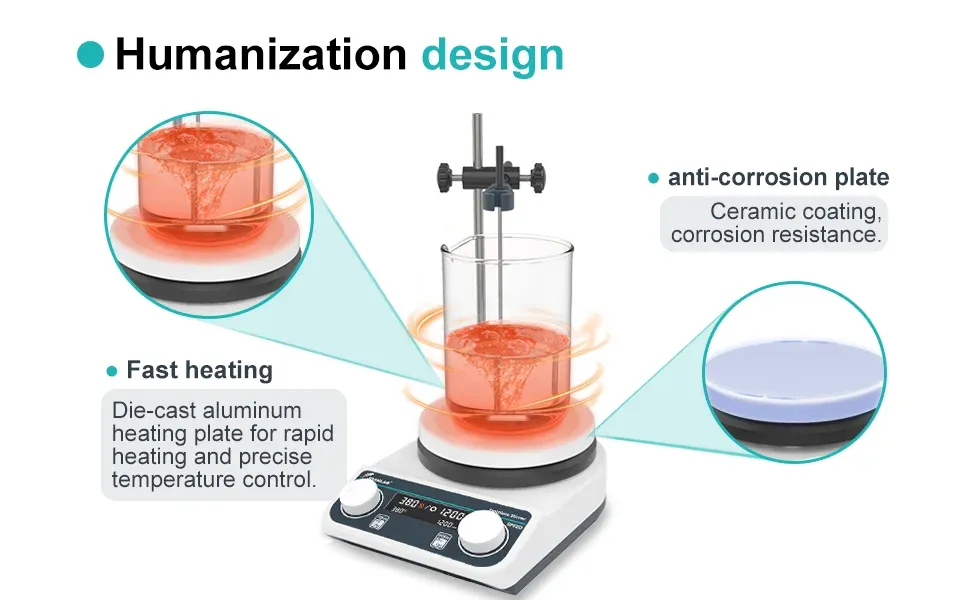
A magnetic mixer stirrer is a laboratory device that uses a rotating magnetic field to spin a stir bar inside a vessel, mixing liquids evenly and, in many models, heating them at the same time. For UK labs, it is a practical choice for routine sample preparation, reagent dissolution, temperature-controlled mixing and low-viscosity formulations because it is compact, easy to clean and well suited to controlled bench work.
TL;DR: If you need reliable mixing for low- to medium-viscosity liquids, a magnetic mixer stirrer offers clean, consistent agitation without the complexity of overhead stirring. In most UK labs, the best results come from choosing a unit with stable RPM control, a chemically resistant top plate, strong magnetic coupling and, where heating matters, accurate temperature support such as an external probe.
Key takeaways
- A magnetic mixer stirrer is best for consistent mixing of liquids in beakers, flasks and similar vessels.
- Models with heating are especially useful for sample prep, dissolving solids and temperature-sensitive processes.
- Ceramic top plates offer strong chemical resistance and are well suited to demanding laboratory use.
- External temperature probe support improves control by measuring the liquid directly rather than estimating from the plate surface.
- For UK buyers, it is sensible to review build quality, safety features, documentation and suitability for your sector’s compliance needs.
What is a magnetic mixer stirrer?
A magnetic mixer stirrer is a bench-top laboratory instrument designed to mix liquids using magnetism rather than direct mechanical contact. In simple terms, the unit contains a rotating magnet or electromagnetic drive beneath the plate. For heated workflows, a combined unit such as our digital magnetic stirrer hot plate with 200–1500 RPM control lets you heat and stir from one bench footprint. When you place a PTFE-coated stir bar inside your vessel, that bar follows the rotating field and stirs the liquid.
As a result, this type of mixing is especially popular in UK laboratories where cleanliness, repeatability and space efficiency matter. It removes the need for shafts or impellers entering the sample from above, which in turn helps reduce cleaning effort between runs in many low-viscosity applications.
MagneStirr systems are particularly relevant where users want dependable stirring with modern controls. The brand’s focus on digital ceramic hot plate stirring and heating with external probe support aligns well with laboratory tasks that need both accurate mixing and better thermal control.
How does a magnetic mixer stirrer work?
A magnetic mixer stirrer works by generating a rotating magnetic field underneath the top plate. Once the vessel is placed on top and the internal drive starts turning, the stir bar inside the liquid rotates at a corresponding speed. Consequently, fluid movement forms around the bar and produces circulation through the sample.
The effectiveness of that circulation depends on several factors:
- the volume of liquid being mixed
- the viscosity of the sample
- the shape and size of the vessel
- the design and length of the stir bar
- the strength of magnetic coupling at different RPMs
For straightforward aqueous solutions, this method is often highly effective. However, thicker mixtures or larger volumes may require careful matching of speed range and torque. In practice, loss of coupling most often happens when the stir bar is too small for the vessel or the speed is raised too quickly.
If you are reviewing accessories as well as base units, it also helps to understand how different bars behave in round-bottom flasks versus flat-bottom beakers. That is why many labs treat the choice of stir bar as just as important as the choice of instrument itself.
What is a magnetic mixer stirrer used for?
A magnetic mixer stirrer is used wherever uniform liquid agitation is needed without intrusive mechanical stirring. Therefore, it appears in everything from teaching laboratories to regulated production support environments.
Common uses in UK laboratories
- preparing buffers and media
- dissolving salts and powders into solution
- mixing reagents before analysis
- temperature-controlled chemical reactions
- sample preparation in university research settings
- formulation work in pharmaceutical, biotech and cosmetics labs
- routine bench work in NHS or clinical support environments where suitable
In practice, these units are valued because they combine consistency with simplicity. Moreover, when heating is integrated into the same platform, workflows become more compact because users do not need separate equipment for basic warming and stirring tasks.
Where heated models are especially helpful
A heated magnetic mixer stirrer can be particularly useful when solubility improves with temperature or when process repeatability depends on maintaining set conditions. For instance, warming solutions while stirring can help dissolve solids faster and more evenly than manual agitation alone. Even so, direct control over actual sample temperature matters far more than headline plate temperature when precision is important.
What should you look for when buying a magnetic mixer stirrer?
How important is speed control?
Very important. Stable speed control affects both mixing quality and repeatability. A unit that can hold RPM steadily under load will generally perform better than one that only reaches high top-end speeds on paper. Accordingly, buyers should assess usable speed range rather than focusing only on maximum RPM claims.
Why does top plate material matter?
The top plate material influences durability, chemical resistance and ease of cleaning. Ceramic plates are widely preferred for many laboratory settings because they resist common chemical splashes well and are easier to maintain visually over time. This matters in busy UK labs where equipment may be used repeatedly throughout the day by multiple operators.
MagneStirr’s emphasis on digital ceramic hot plate designs addresses this need directly. In day-to-day use, ceramic can be particularly advantageous where corrosive reagents or regular wipe-down protocols are part of normal bench practice.
Do you need heating?
If your work involves dissolving solids faster, controlling reaction conditions or keeping samples at set temperatures during mixing, then yes: heating may be essential rather than optional. On the other hand, if you only mix ambient-temperature solutions occasionally, an unheated model may be sufficient.
Is external probe support worth it?
In many cases, absolutely. External probe support allows temperature measurement within the liquid itself rather than relying solely on hotplate surface estimates. As a result, users can achieve tighter process control where media temperature has to remain within specified limits.
In practice, external probes improve consistency when batch quality depends on the actual sample temperature rather than the nominal plate setting. This is especially valuable in formulation work and repeatable method development.
How much volume can a magnetic mixer stirrer handle?
Most benchtop magnetic mixer stirrers are specified by a maximum stirring volume in water-like liquids; the MagneStirr digital unit is rated for up to 3L. Treat that as a ceiling for low-viscosity work: as volume, viscosity or vessel size rise you need a longer stir bar and steadier torque, and eventually the magnetic drive can no longer keep the bar coupled. As a rough guide, magnetic stirring stays comfortable up to around 500 cP; thicker gels or slurries call for an overhead mechanical stirrer instead.
Is a magnetic mixer stirrer good value for a UK lab?
For a startup or small lab watching cash flow, a magnetic mixer stirrer is usually the sensible core buy: it covers buffers, media and reagent mixing without the premium you pay for the extra channels and programmes on an IKA- or SCILOGEX-class instrument that you may never use. The honest question is what you actually run day to day. If your work stays within roughly 3L of low- to medium-viscosity liquid, a mid-priced digital unit like MagneStirr's — £262.65 inc VAT (£218.88 ex VAT), with free UK delivery and a 30-day return window to check it fits your bench — covers it comfortably. If you routinely need very high torque, sealed inert-atmosphere work or many programmable ramps, budget for a premium system instead.
Two related reads help you specify correctly: choosing a magnetic stirrer with hot plate if you need heating, and the guide to magnetic stirrer bars so the bar matches your glassware. For the underlying mechanism, see how a magnetic stirrer works.
Need a digital hot plate stirrer for your bench?
Shop 3L Hot Plate Stirrer — £262.65Free UK delivery · CE/UKCA · 2-year warranty · 30-day returns